
Everything Bagel Focaccia
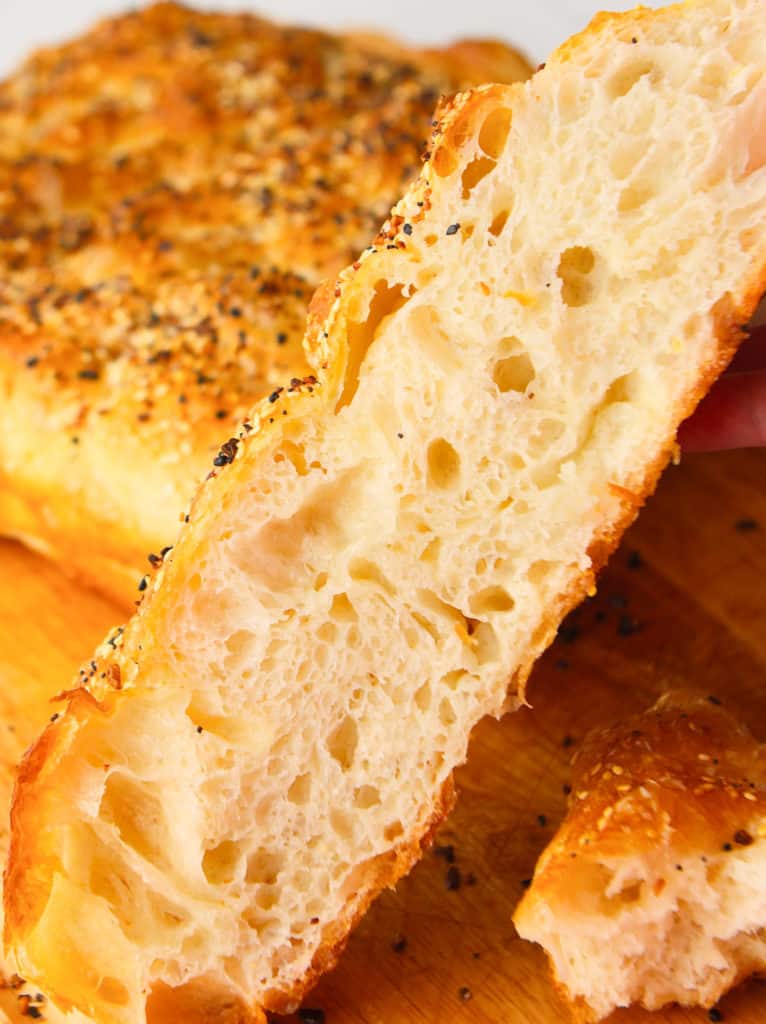
This Everything Bagel Focaccia takes my classic no-knead focaccia recipe and combines the bold, essence of an everything bagel. The airy texture is complimented perfectly with the savory blend of poppy seeds, sesame seeds, minced garlic, minced onion and salt.
Ingredients
- 500 ml warm water
- 1 Tablespoon sugar
- 1 Tablespoon sea salt NOT table salt
- 2 teaspoons instant yeast see note below if using active dry yeast
- 1 Tablespoon olive oil
- 550 g bread flour
- 2 teaspoons Everything Bagel seasoning
Click between "US Customary" or "Metric" button above to switch between conversions. For precise results, it's recommended to weigh your dry ingredients using a digital scale in grams as measuring in cups can have uncertainties.
Instructions
Before you start
- Read my directions, expert tips and FAQ before beginning.
Make the dough
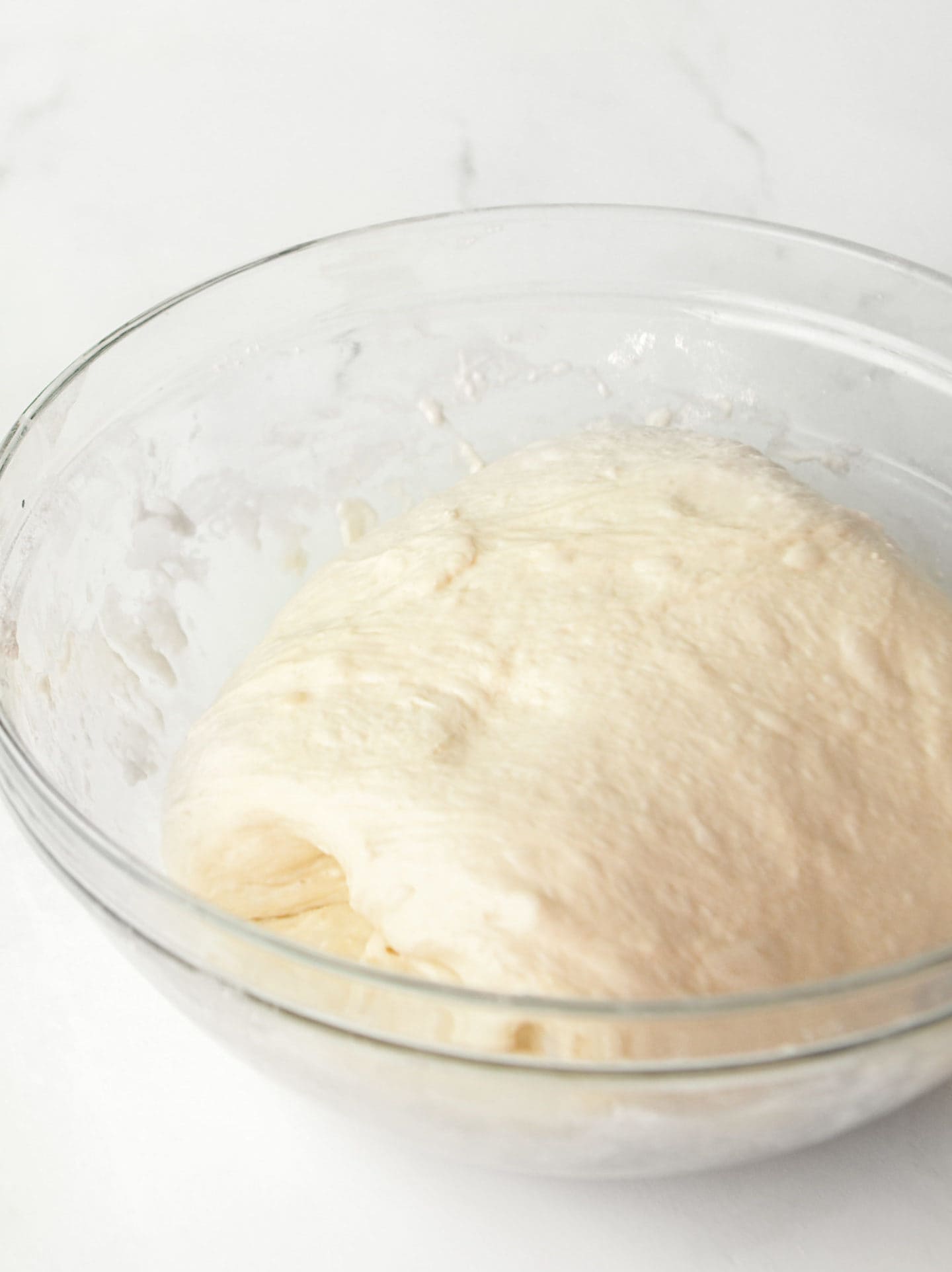
- To a large mixing bowl, add all the ingredients in order as listed except the flour. Whisk together, then add the flour. Use a Danish dough hook or the neck of a wooden spoon to mix for at least 1 minute until the dough is wet and sticky. Cover with a tea towel and allow the dough to rest for 10 minutes.Note: Instant yeast can mixed directly with dry ingredients and active dry yeast must be dissolved in warm liquid first to be "activated" before use. Measure out water from the recipe, stir in the active yeast with a pinch of sugar. Let it sit for 5-10 minutes until its foamy or bubbly. Note: This recipe uses sea salt, which has larger, coarser grains compared to fine table salt. This affects the quantity of salt and the saltiness in the bread. If you don't have sea salt, reduce the salt measurement to 2 teaspoons.500 ml warm water, 1 Tablespoon sea salt, 1 Tablespoon sugar, 2 teaspoons instant yeast , 1 Tablespoon olive oil, 550 g bread flour
Stretches
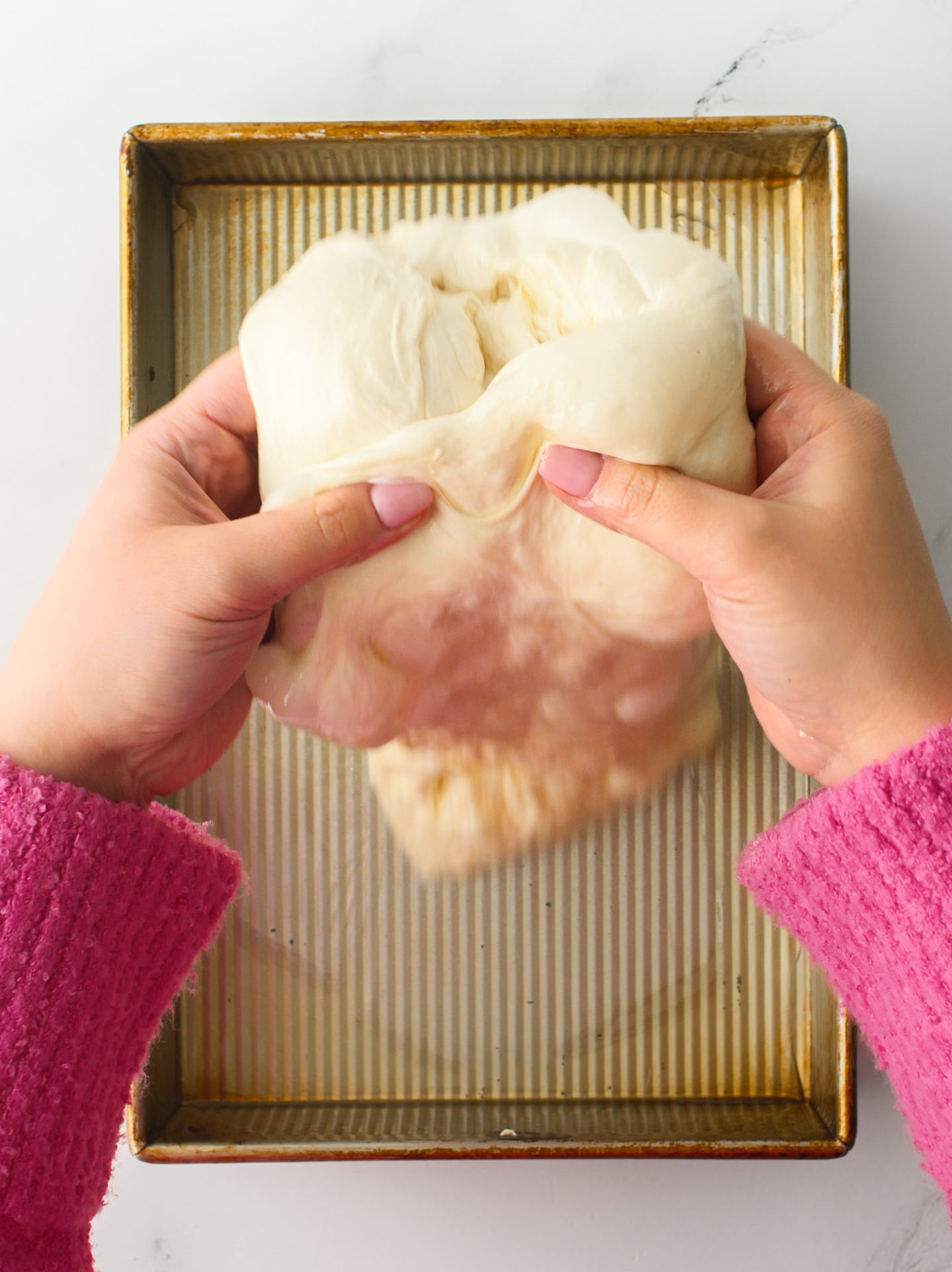
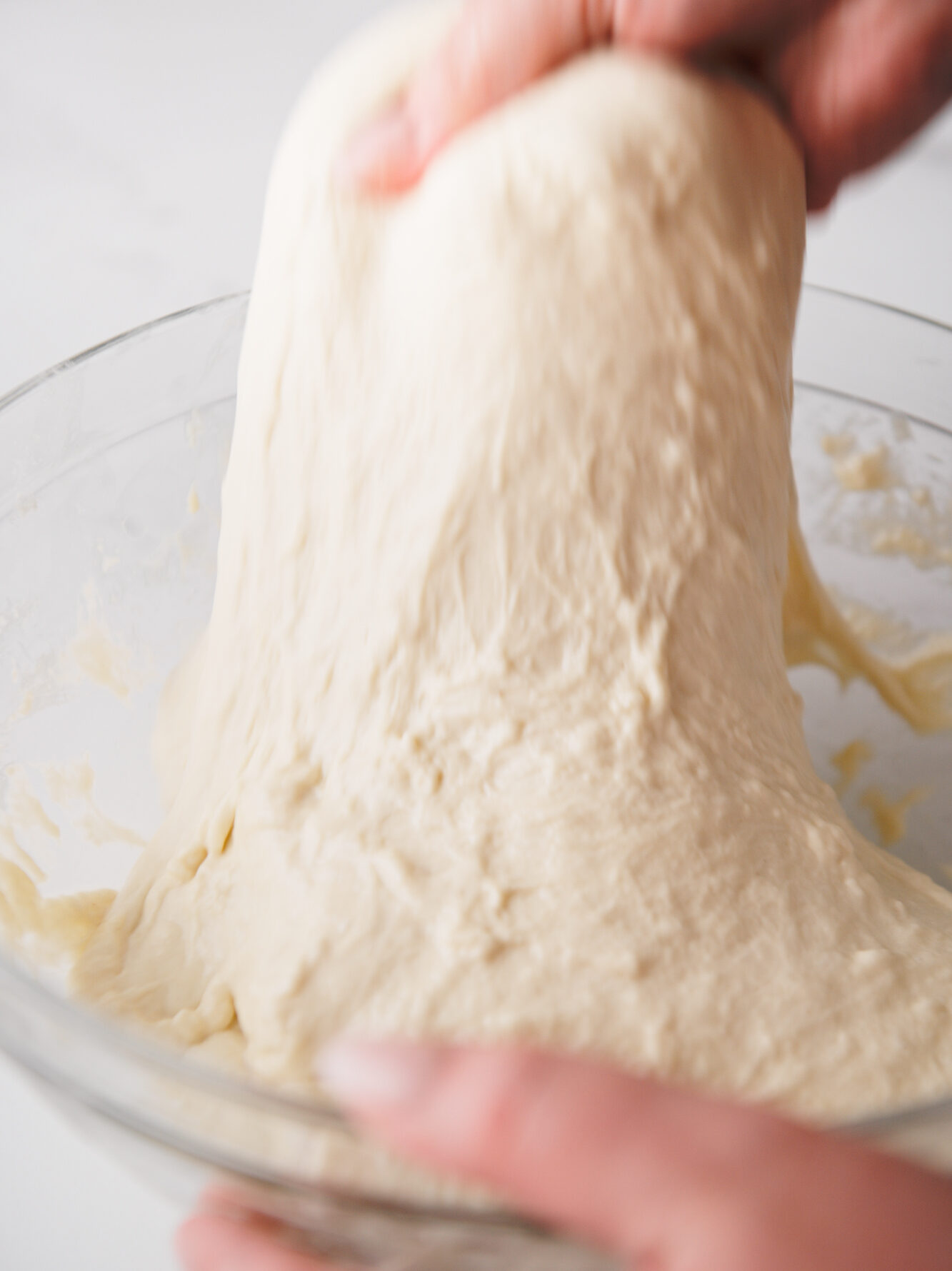
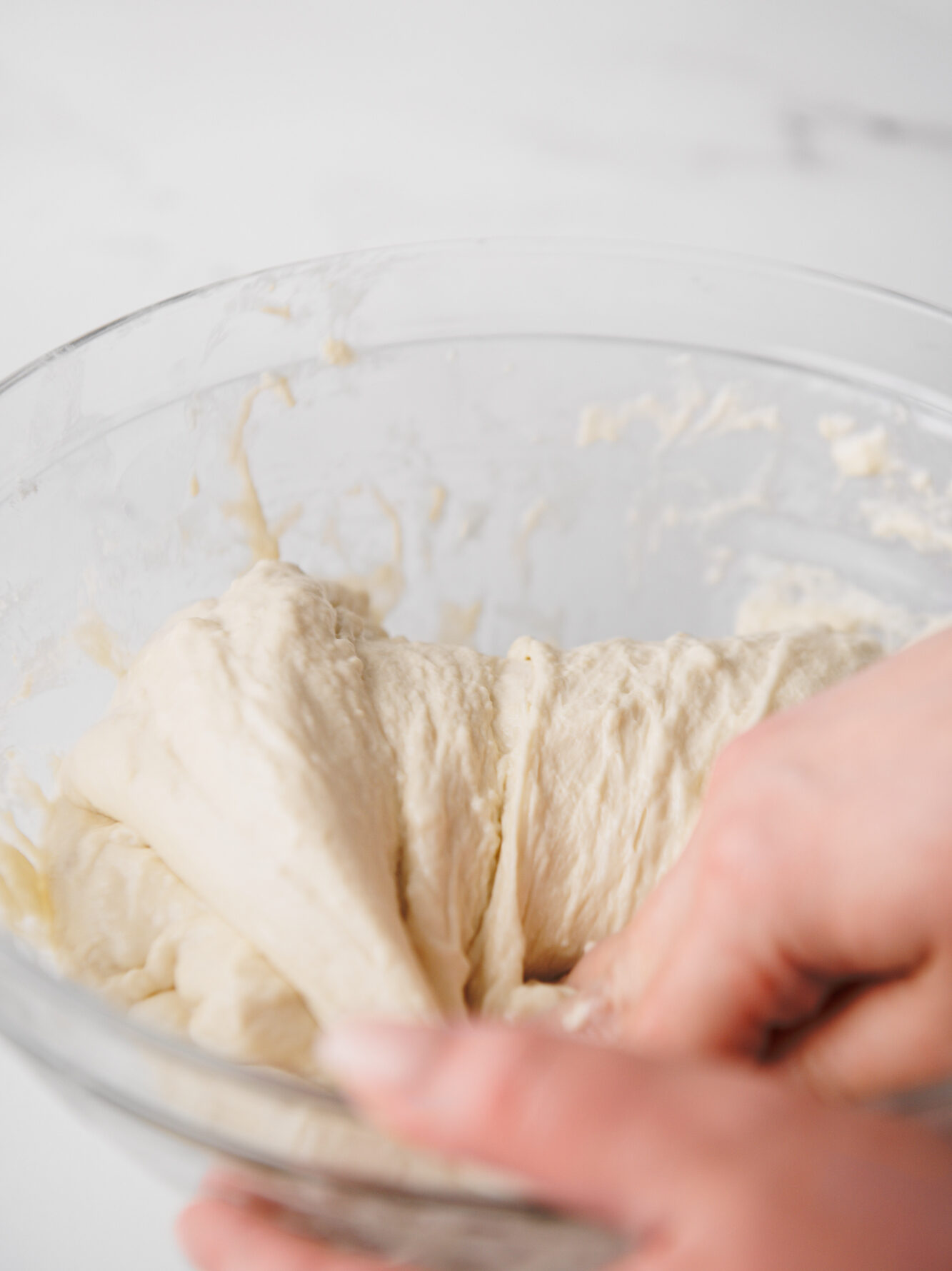
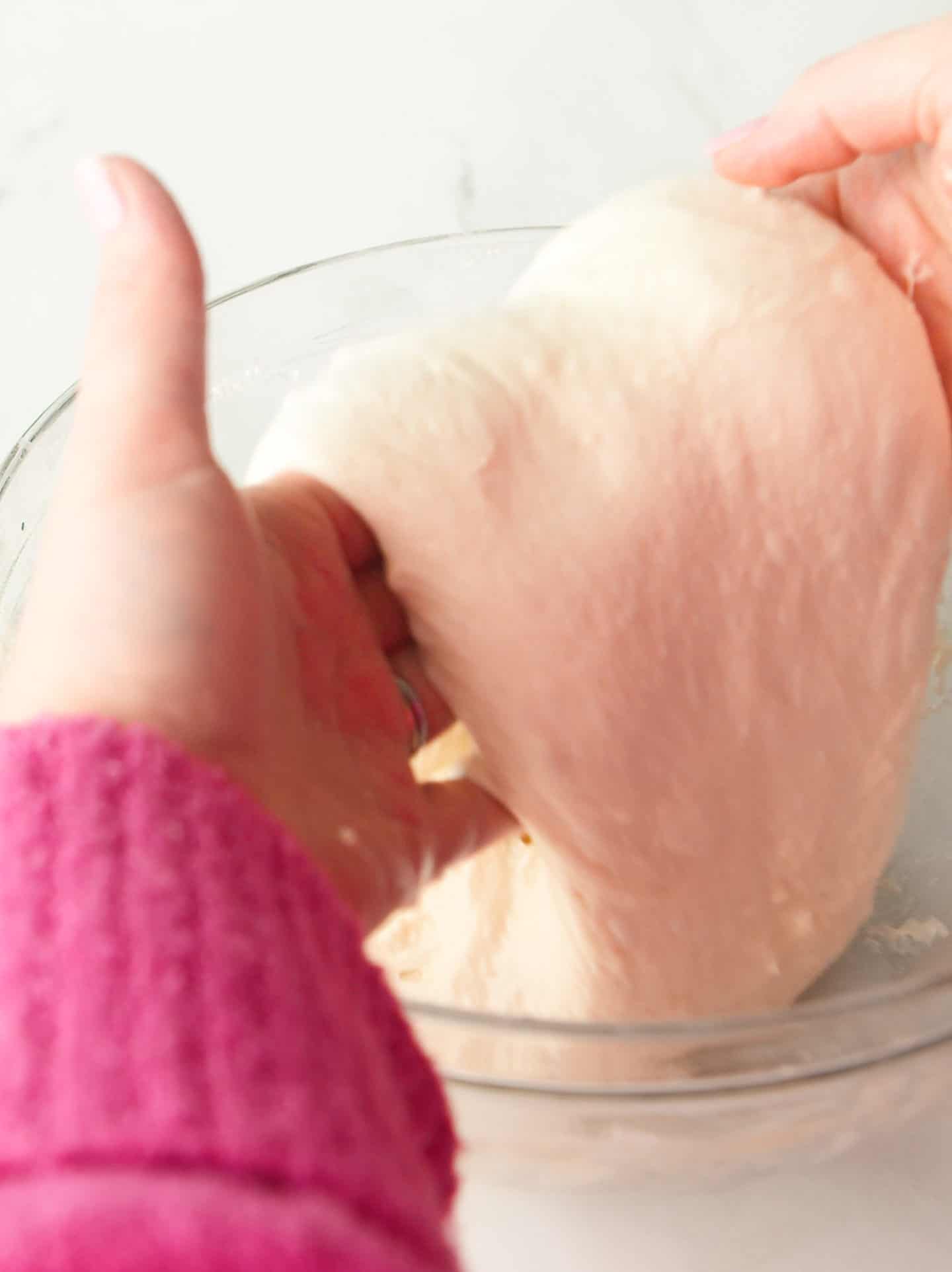
- Once the dough has rested for 10 minutes, it's time for the stretch and folds. For this recipe, I have recently adapted two types of stretches.STRETCH AND FOLD METHOD: This is the first type of stretch. First, wet your hands before proceeding as it will make it easier to handle the dough. Work your way around the dough like you are looking at clock. Perform a fold at 12, 3, 6 and 9 o’clock by pulling the dough up and over to the other side of the bowl. Cover with a tea towel for 10 minutes.COIL METHOD: This is the second type of stretch. Wet your hands again. Gently loosen the edges of the dough by pulling it away from the sides of the bowl. Place your fingertips under the dough, so that you can pick it up in the middle. Allow the dough to unstick from the bowl and fold using its own weight, while you support the middle. Turn the bowl 90° and repeat to perform another coil fold. Do this method 3 more times, 10 minutes apart.
First rise
- Coat the entire focaccia and bowl with oil, about 3 Tablespoons. Cover the bowl with plastic wrap and a tea towel. Let it rise in a warm spot at room temperature for at least 1 to 1 ½ hours or in the refrigerator for 4 to 12 hours. Read more about my alternative rising schedules in this blog post.
Prep the dough
- Remove the plastic wrap. Move the bowl back and forth, opening up the bubbles and allowing the dough to breathe. Coat a generous layer of olive oil on the bottom of a 9"x13" inch aluminum, non-stick baking pan. For good measure, you may also line the bottom with parchment paper prior to drizzling the oil. Pour the dough into the pan. The dough may seem to "deflate" but don't fret.
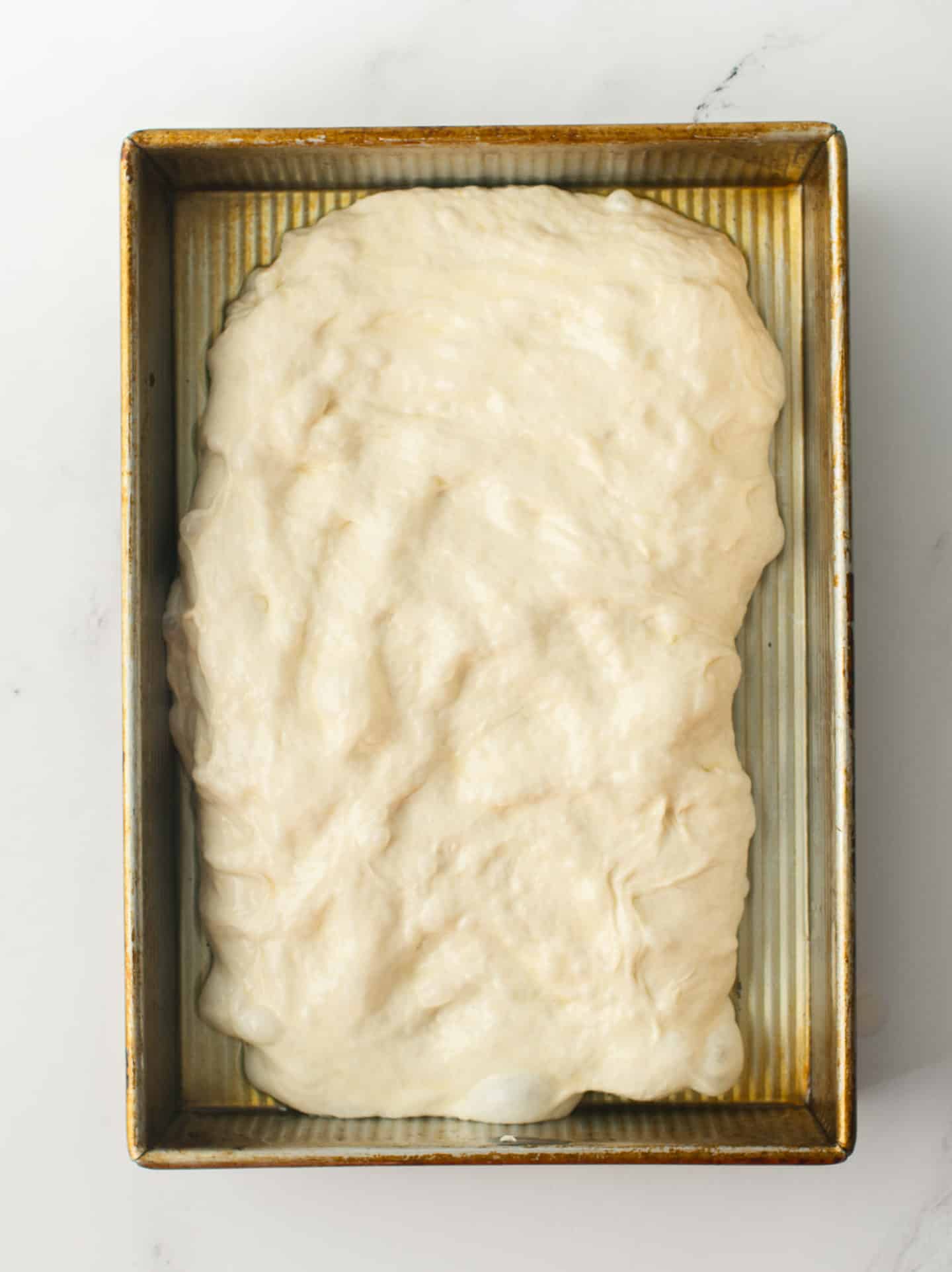
- Fold the dough into thirds. Then, rotate 90 degrees so that the dough is in line with the pan and flip over, revealing the smoother side on top. Gently spread the dough into the corners with your fingertips but don't force it.
Second rise
- Cover with plastic wrap and place in a warm spot at room temperature for at least 1 hour. The dough will continue to stretch and rise into the corners in this final proof. Please note, if you followed the refrigeration sample schedule, you need to let the dough come to room temperature and this may take between 2 hours but up to four hours until the dough no longer feels cold and springs back when you press on it.
Preheat the oven
- Preheat the oven to 450°F / 232°C.
- When the oven is done pre-heating, remove the plastic wrap and lightly drizzle the top of the dough with olive oil.
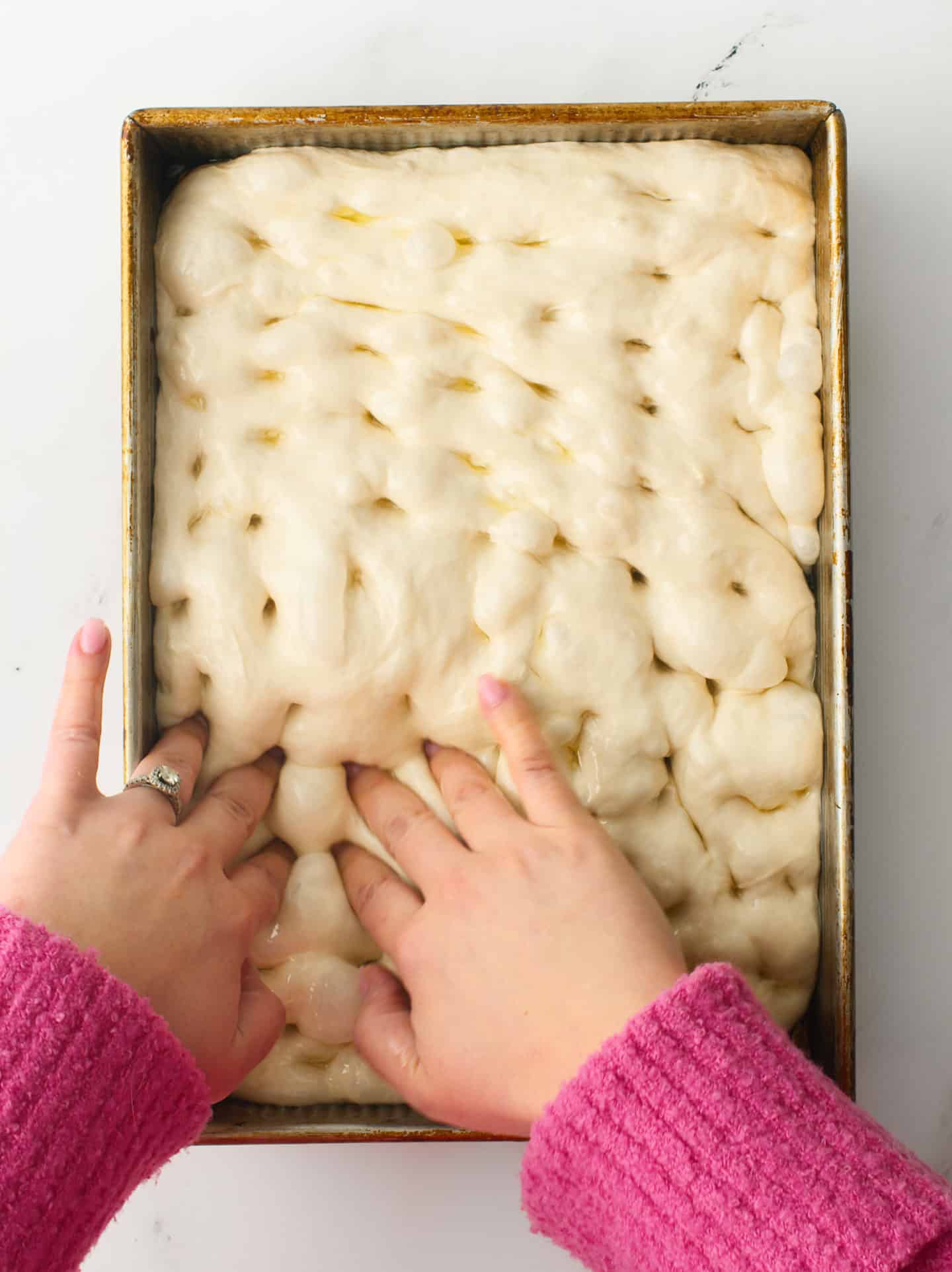
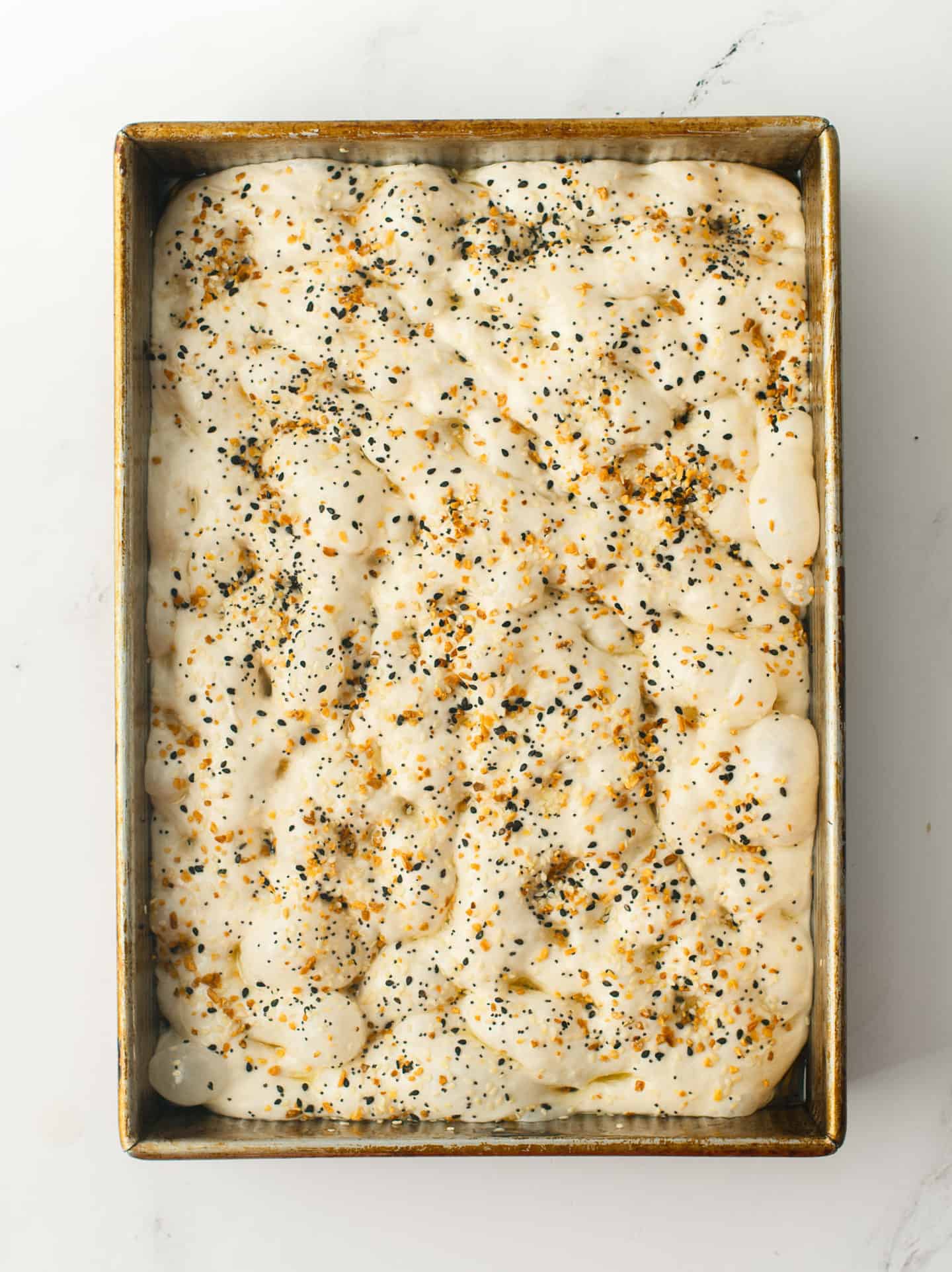
- Coat your fingertips with some of the oil. This helps prevent sticking as you make your dimples. To do that, use your fingertips to press into the dough, creating soft indentations and bubbles on the entire surface. The dough should slowly spring back. We are looking for jiggly dough.2 teaspoons Everything Bagel seasoning
Bake
- Sprinkle the top with Everything Bagel seasoning. Place into the oven for 22-24 minutes until golden brown and crispy. Depending on the strength of your oven, baking time may vary by a few minutes.
- Leave the focaccia in the pan for at least 10-15 minutes before transferring to a wire rack to cool before slicing.
Notes
- Instant yeast can mixed directly with dry ingredients and active dry yeast must be dissolved in warm liquid first to be "activated" before use. First, heat up the water until its lukewarm. Stir in the active yeast and a pinch of sugar. Let it sit for 5-10 minutes until its foamy or bubbly.
- Store leftovers at room temperature, wrapped completely in plastic wrap and a tea towel, up to two days. It makes amazing sandwiches the next day. Always toast leftover focaccia in the oven to revive the texture. If your focaccia has toppings like cheeses and meats, please consume same day. It should never be stored in the refrigerator as the environment is very drying.
- Overnight schedule sample: Once you've completed the stretch and folds, oil the bowl, place in the fridge, cover with plastic wrap and refrigerate for as little as 2 hours to as long as overnight. After the first rise, transfer to a generously oiled non-stick baking tray and follow the rest of the recipe directions. Let it rise at room temperature for anywhere between 2 hours but up to 4 hours until the dough no longer feels cold and springs back when you press on it.
Nutrition
Calories: 180kcalCarbohydrates: 34gProtein: 5gFat: 2gSaturated Fat: 0.3gPolyunsaturated Fat: 0.5gMonounsaturated Fat: 1gSodium: 648mgPotassium: 46mgFiber: 1gSugar: 1gVitamin A: 1IUCalcium: 7mgIron: 0.4mg
The provided nutritional value above is an estimate per serving. 100% accuracy is not guarenteed. Please see Nutrition Information Disclaimer in our Privacy Policy.
Nutrition Information Disclaimer Have you tried this recipe?Please leave a comment/review below!



Hello! My dough is in its first rise but I may have misunderstood your directions. I chose the 3,6,9,12 fold method. Should I have done 3 sets with 10 minutes in between? Or is that just for the coil method? I only did one set of the 3,6,9,12. If I did this wrong, should I do folds anyway? It’s got olive oil all over it now…
Hi Carol, thank you for your question! You are on the right track. Do the stretch and fold once, then do the coil method three times, 10 minutes apart. You may also chose to only perform the stretch and fold method. This recipe is very forgiving. I hope this helps! 🙂
Hi Patricia, I’m looking forward to trying this amazing looking focaccia recipe, thank you. You mentioned in the notes that it’s best to weigh all the wet and dry ingredients, but I can’t seem to find the weight equivalents for any of the ingredients except the flour. How much does a tablespoon of salt weigh? And 2T of sugar? Or any of the others that are listed in imperial measures or in mL? Thanks in advance for you help 🙂
Hi Karren, thank you for your questions! The biggest factor that affects the success of a high hydration bread such as focaccia is the amount of water and flour. That’s why the measurements for those two ingredients in particular are in metric. The other measurements are not as necessary to be exact per say but for your reference, use the following: 12 grams sugar and 10 grams sea salt. I know that’s a long explanation but I hope it helps. I have no doubt your going to love our focaccia. 🙂
Thank you very much for this recipe and for your effort in putting everything together so neatly, Patricia! Directions, explanations, pictures, the video…
You literally can’t imagine how happy I was yesterday when I finally got bubbles and a jiggly dough! (After many, many attempts).
This will be my to-go focaccia recipe from now on. I am truly thankful!
All the best!
Thank you for such a lovely review! We enjoying hearing how our blog is helpful for bakers of all levels. 🙂 Happy baking!
Is there any adjustment needed for high altitude? I’m at 5,000 feet MSL.
Hi Tyler! Though I am not fully experienced in changes to recipes, I can give you a few tips I am knowledgeable in. Because of the lower pressure and humidity at higher altitudes, which affects dough rising and baking, consider these things: reducing the yeast by 25% to prevent over-fermentation, keep a close eye on rising time as dough tends to rise faster in those environments, and depending on the humidity, you may need to slightly adjust water and flour to get the right consistency as seen in my tutorial videos and photos. This focaccia recipe is forgiving and I wouldn’t worry too much. I hope this helps. 🙂
Here is the thing…. Only recipe for focaccia you’ll ever need. PERIOD! Bubbles…. The texture, the flavor…. The compliments when you bring this to an event…. I wish I could say it’s my recipe… it’s that good!!!
That’s so sweet! Thank you, Raluca! 🙂
I recently made the everything bagel focaccia and was very pleased with the final outcome! I definitely had my doubts as to how this would turn out but trust me, you will not be disappointed. The recipe was easy to follow and I really liked having photos as well as the reel on Instagram to make references to as the recipe progressed. Thank you so much! Can’t wait to try this again!
Hi Christine, what an honor to receive this kind compliment on my recipe! 🙂
Just made this today. Followed the recipe process (room temp first prove) but seasoned with seasalt rosemary and garlic slices and poked then into the dough.
I was really impressed, it looked so professional. I’m going to be making this again very soon and trying out different flavours.
Hi Jess! Wow, thanks so much for this lovely review! So happy to hear you enjoyed my recipe. Looking forward to hearing about your other experimental flavors.
When using active dry yeast and dissolving it in 1/4 cup (59ml) of water, would I then subtract that amount from the 500ml of water in the “instant dry yeast” recipe?
Same applies to the sugar? Thank you!
Hi Felix, thank you for your question! To clarify, if you are activating in the way you mentioned above, then yes, subtract from the total 500ml. Typically, when I use Active Dry Yeast in my focaccia recipe, I will weigh and measure the recipe quantity of water and sugar first in the large mixing bowl. Then, I will sprinkle the yeast over, whisk and let it rest to activate. Then, I’ll add flour to the same bowl and proceed with directions. I hope this helps!
Yes, I could sorta tell by the consistency of the dough also but thank you much for clarifying. Turned out amazing…starting more tonight for tomorrow’s SB party!!
Yay! Happy Baking!
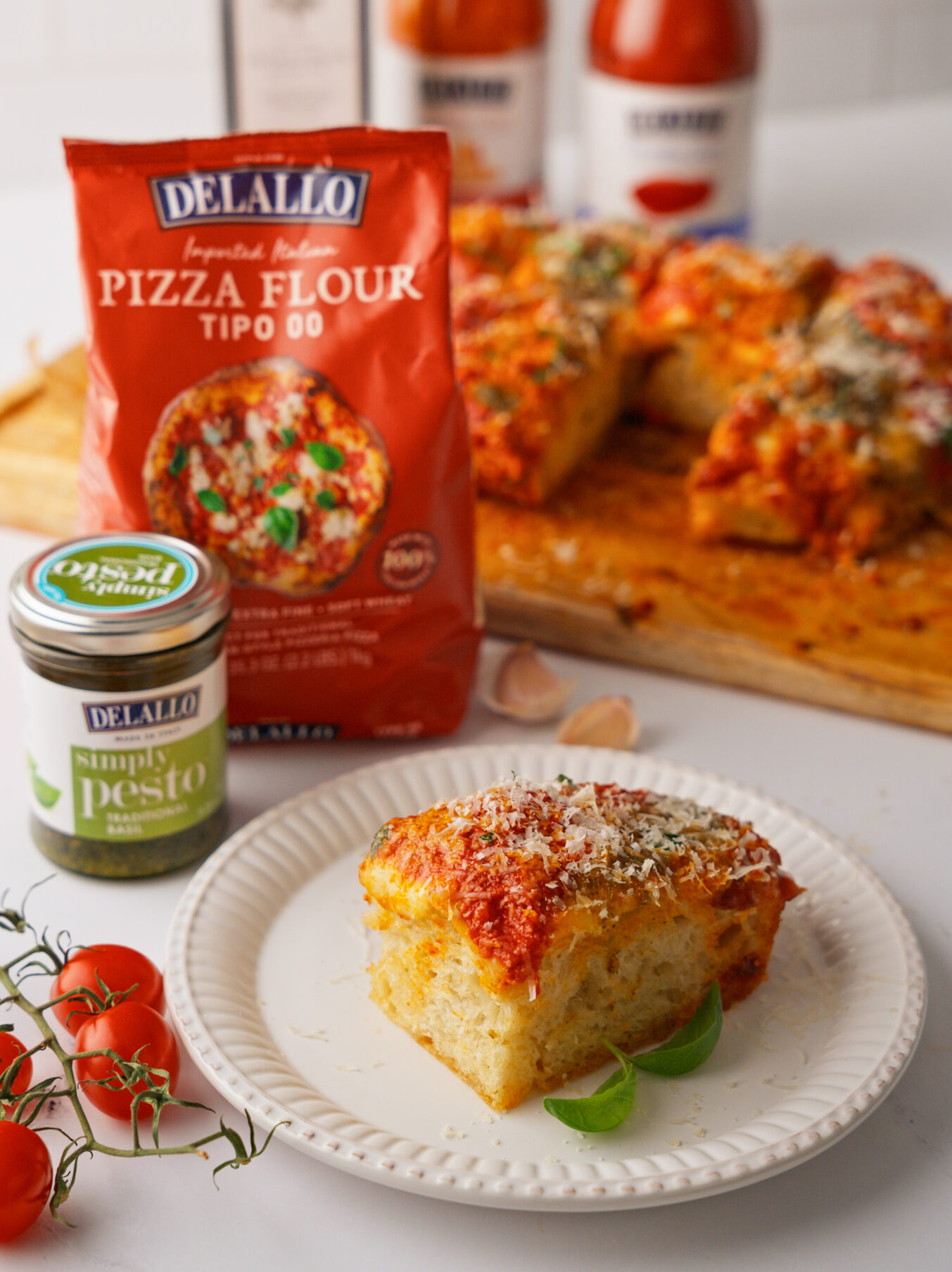
What about 00 type flour. Isn’t it the preferred type of flour for pizzas and focaccias?
You can definitely substitute with 00 flour. For some, it may be harder to access but it works great in bread recipes. As we know, 00 flour has lower protein content than bread flour. Any substitutes to my original recipe may change the texture and bread structure. I’m sure the end result is delicious! Thank you for pointing this out.
Your original focaccia recipe is the best bread recipe I’ve ever used. This one tastes like an ultra fluffy bagel. I can’t wait to make sandwiches out of it. You’re a bread master. Thanks so much.
Thank you, Kathy! So happy you enjoyed our recipe.
Can I use AP flour? Stores here don’t carry bread flour. Thanks
Hi there! In that case, All-purpose flour will work just fine. Substitute in a 1:1 ratio. The texture may be a little bit different because bread flour has a higher protein content but overall, the bread will still turn out delicious. I hope this helps.
This looks so good! I’ve always wanted to try to-make it.
Do you have a subscription form? I can’t find it.
Thank you so much for the step by step instructions – Im not sure I would have succeeded without them – my family and I thought it was perfect – first try!!
Thank you, Donna!
Thank you! I wish you much success on this recipe! The subscription pop-up is fixed and working.